
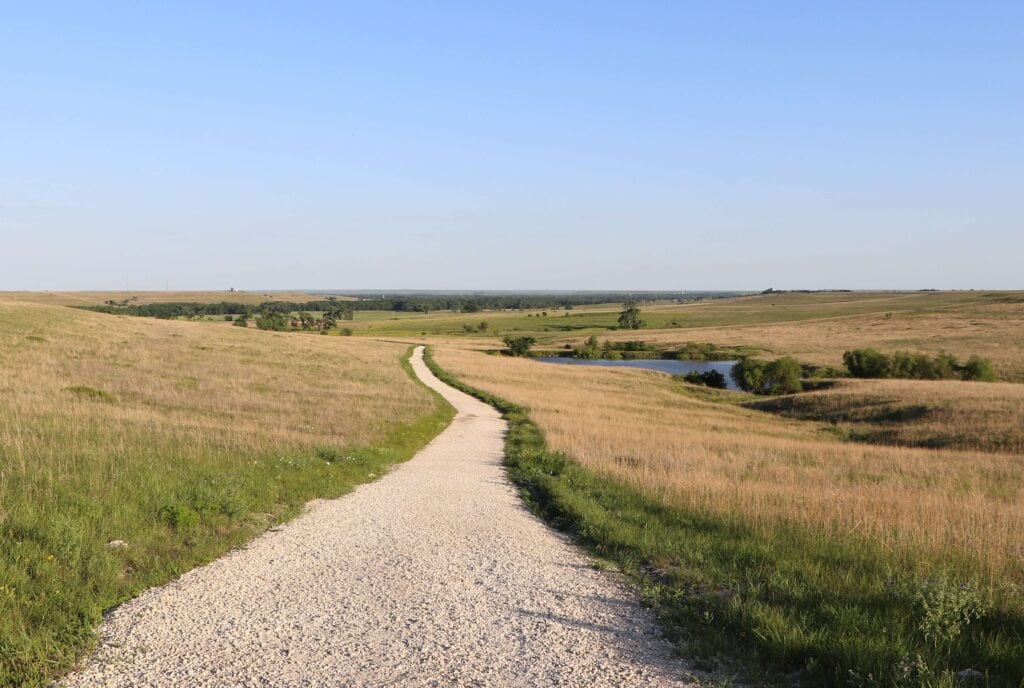
Hiking trails in Kansas show you a side of the state most people never expect to find. The state gets a bad reputation for being flat and boring, but head out to the right spots and you will find limestone bluffs, deep canyons, wide prairies, and some of the last intact tallgrass in North America. These trails take you through quiet forests, past free-roaming bison, and along lakeshores where you can walk for miles without seeing another person.
Kansas offers trails for everyone. Some paths roll gently through prairie grasses. Others demand you scramble over rocks and cross creeks. The variety surprises visitors who thought they knew what Kansas looked like. We work with landowners across the state and see firsthand how much people value these outdoor spaces. If you are thinking about Kansas land for sale, consider how close you might be to these trails and the kind of access you want to natural areas.
1. Tallgrass Prairie National Preserve
Trail Length: 0.75-9.6 miles
Difficulty: Easy to Moderate
Elevation Gain: 104-534 feet
Estimated Time: 1-6 hours
Trail Type: Out and back, loops
The Tallgrass Prairie National Preserve near Strong City protects what 170 million acres of North America used to look like before most of it got turned into farmland. The preserve covers almost 11,000 acres with over 40 miles of trails cutting through grass that grows taller than your head during peak season. The most popular route is the Windmill Pasture Hilltop Trail at 3.1 miles with 160 feet of elevation gain. You get rolling limestone hills, endless views across the Flint Hills, and a herd of bison roaming free in the pastures. Spring brings wildflowers and new grass. The bison add an unpredictable element to the experience, so pay attention to where they are and give them plenty of space.
2. Konza Prairie
Trail Length: 2.6-6.3 miles
Difficulty: Moderate
Elevation Gain: 275-469 feet
Estimated Time: 2-4.5 hours
Trail Type: Loop
Konza Prairie sits about 10 miles south of Manhattan and functions as a research station for Kansas State University while remaining open to the public for hiking. Three loop trails cover 2.6, 4.6, and 6.2 miles through authentic tallgrass prairie that Kansas State manages with controlled burns just like the original ecosystem. The Nature Trail Loop covers 2.6 miles with 275 feet of gain. Kings Creek Loop runs 4.4 miles with 410 feet of gain. The longest Godwin Hill Loop stretches 6.0 miles with 469 feet of gain. The trails wind through lowland forest, cross Kings Creek, and climb limestone ledges until you reach the high prairie with views of the Flint Hills and Kansas River Valley. You cannot bring dogs here because they disrupt the research happening on the land.
3. Elk River Trail
Trail Length: 15 miles
Difficulty: Moderate
Elevation Gain: 950 feet
Estimated Time: 5-8 hours one way
Trail Type: Point to point
The Elk River Trail near Independence runs 15 miles along Elk City Lake through terrain you would not expect to find in Kansas. This National Recreation Trail climbs limestone bluffs, drops into narrow canyons, winds through cedar forests, and crosses several small creeks before reaching the Elk River. The Chautauqua Hills rise up to 200 feet above the surrounding area, and the trail takes full advantage of this elevation with panoramic views from the clifftops. You can start at the east trailhead near the lake or the west trailhead near the US-160 bridge. Backpacker magazine rated this the best hike in Kansas, and primitive camping is allowed anywhere along the trail. Summer gets hot in those canyons with no air movement, so bring extra water.
4. Flint Hills Trail State Park
Trail Length: 118 miles total
Difficulty: Easy
Elevation Gain: Minimal
Estimated Time: Varies by section
Trail Type: Point to point
The Flint Hills Trail became a Kansas state park in 2018 and runs 118 miles from Osawatomie to Herington across the eastern part of the state. This former Missouri Pacific Railroad line got converted into a crushed limestone path that works for hiking, biking, and horseback riding. About 93 miles from Osawatomie to Council Grove are currently open and improved, while the western section to Herington remains rough railroad ballast. The eastern portion follows the Marais des Cygnes River through farmland and riparian forests. The central section takes you into the Flint Hills proper with those endless prairie views. Multiple trailheads let you pick shorter sections. The Rails-to-Trails Conservancy inducted this trail into its Hall of Fame in 2025.
5. Little Jerusalem Badlands State Park
Trail Length: 0.5-2.5 miles round trip
Difficulty: Easy to Moderate
Elevation Gain: 36-88 feet
Estimated Time: 30 minutes to 2 hours
Trail Type: Out and back
Little Jerusalem Badlands sits in western Kansas between Oakley and Scott City, protecting the largest exposed Niobrara Chalk formation in the state. These white limestone spires and canyons rise over 100 feet above the surrounding prairie, deposited 80 million years ago when Kansas sat under a shallow sea. The Overlook Trail covers 0.25 miles one-way with just 36 feet of elevation gain and gets you to the first viewpoint fast. The Life on the Rocks Trail runs 1.25 miles one-way with 88 feet of gain and winds along the canyon rim with multiple viewpoints. The Nature Conservancy owns this 332-acre property and partners with Kansas State Parks to manage visitor access. The chalk formations are fragile and erode easily, so walking or climbing on them is not allowed. Guided tours let you hike into the interior of the formations, but you need reservations for those.
6. Kanopolis State Park
Trail Length: 1-30+ miles, depending on the trail
Difficulty: Moderate to Difficult
Elevation Gain: Varies
Estimated Time: 1-5 hours
Trail Type: Loop and out-and-back options
Kanopolis State Park was the first state park in Kansas and sits in the Smoky Hills region with Dakota sandstone bluffs and deep canyons. The park offers over 30 miles of multi-use trails for hiking, mountain biking, and horseback riding. Buffalo Track Canyon Nature Trail covers 0.95 miles one-way, following Bison Creek through the canyon with numbered posts explaining the geology and history. The Horsethief Canyon Trail runs 1.9 miles as a loop with 150 feet of elevation gain, winding between rock walls with three water crossings and caves carved into the bluffs. For longer hikes, the full trail system connects into an 8.3-mile loop crossing pastures, canyons, and creeks. The Horsethief Canyon and Smoky Hill River route stretches 9.1 miles with 761 feet of elevation gain for the most challenging option. The water crossings can run deep after rain, and this area gets ticks in warm weather, so dress accordingly.
7. Fancy Creek Trail (Tuttle Creek State Park)
Trail Length: 6 miles
Difficulty: Moderate to Difficult
Elevation Gain: 180 feet
Estimated Time: 2-3 hours
Trail Type: Loop
Fancy Creek Trail at Tuttle Creek State Park near Manhattan gives you six miles of challenging terrain through oak-hickory forest along the lakeshore. This trail gets steep in sections with significant elevation changes for Kansas, making it popular with runners and experienced hikers looking for a workout. The path follows Fancy Creek drainage and climbs ridges that overlook Tuttle Creek Lake. Dogs can come on leash. Spring brings wildflowers blooming under the tree canopy. The trail can get muddy after rain, especially in low-lying sections near the creek. Tuttle Creek Lake covers 12,500 acres and offers 100 miles of shoreline with multiple access points.
8. Perry State Park
Trail Length: 20 miles total in park
Difficulty: Easy to Moderate
Elevation Gain: 50-200 feet
Estimated Time: 30 minutes to 3 hours
Trail Type: Loop options
Perry State Park sits along Perry Lake between Lawrence and Topeka with about 20 miles of hiking and biking trails through an oak-hickory forest. The longest trail system offers about five miles of connected paths that follow the lakeshore and climb through wooded ridges. Old Townsite Nature Trail covers about one mile through forest recovering from its past as farmland. Perry Lake covers 11,000 acres with 160 miles of shoreline, and the trails give you access to quiet spots along the water. The park offers cabins, camping, and fishing. Spring brings wildflowers in the understory. Fall colors turn the oak forest into shades of red and gold. The park charges a vehicle permit fee and offers trail maps at the office.
9. Overland Park Arboretum Trail
Trail Length: 6 miles total
Difficulty: Easy to Moderate
Elevation Gain: 19-370 feet
Estimated Time: 30 minutes to 3 hours
Trail Type: Loop options
The Overland Park Arboretum sits in the Kansas City metro area and offers 300 acres of gardens, prairie, and natural areas with about six miles of interconnected trails. Individual trails range from half-mile walks to the 6.2-mile Overland Prairie Loop with 370 feet of elevation gain. The Bluff Loop Trail covers 2.4 miles with 164 feet of gain through wooded areas with creeks and limestone formations. This is not wilderness hiking but rather a mix of cultivated gardens and restored native landscapes. The trails wind through different themed gardens, cross through oak-hickory forest, and loop through tallgrass prairie plantings. Spring brings flowering trees, summer offers native wildflowers, and fall delivers colors in the wooded sections.
10. Indian Creek Trail
Trail Length: 17 miles (Kansas portion)
Difficulty: Easy
Elevation Gain: 354 feet
Estimated Time: Varies by section
Trail Type: Point to point
Indian Creek Trail runs 17 miles through Kansas City suburbs from Olathe to the Missouri state line, following the creek through parks, neighborhoods, and green spaces. This paved path, about 10 feet wide, stays mostly flat with just a few short hills, making it popular with walkers, runners, and bikers who want an easy route off the roads. The trail weaves through wooded sections along the creek and connects multiple community parks with playgrounds and facilities. Historical markers along the way tell stories about the area before the suburbs took over. You can park at multiple trailheads and do as much or as little as you want.
The Trail That Leads Home
Walking these Kansas trails changes how you see the state. The wide skies, quiet spaces, and surprising landscapes make you realize how much open land still exists here, worth protecting. Small towns dot the prairie between trail systems, and the people who live near these places understand the value of keeping some ground wild.
We see this connection every day, working with people interested in Kansas property. Land here offers something you cannot get in crowded states, like room to breathe, trails to explore, and communities that still value the outdoors. If you are thinking about buying land in Kansas, consider how these trails and natural areas fit into what you want from a property. Access to hiking, hunting, or just walking your own ground matters more than most people realize until they have it. Kansas gives you space to build that kind of life, and these trails show you what the landscape offers when you take time to explore it on foot.