
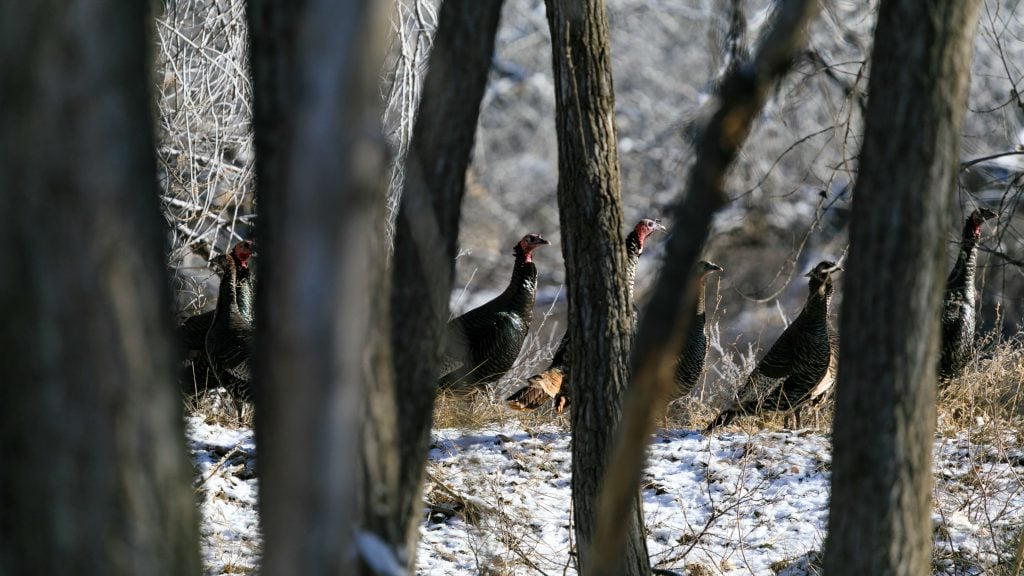
Key Takeaways
- Kansas holds two wild turkey subspecies: Rio Grande (western two-thirds, Units 1, 2, 4, 5) and Eastern (northeast and southeast, Units 3 and 6). Central Kansas produces hybrids where the ranges overlap.
- Spring 2026 season: Youth and disabled April 1-14; archery only April 6-14; regular season (firearm and archery) April 15 to May 31. Bag limit is one bird per spring permit.
- Statewide turkey populations peaked in 2008 and have declined for 15 consecutive years. The fall turkey season is currently suspended statewide.
- Unit 4 in the mid-to-southwest has limited permit availability and has required a draw in some years. All other units sell spring permits over the counter.
- Kansas is one of very few states where a hunter can take both Rio Grande and Eastern subspecies in a single spring season, making it a legitimate Grand Slam destination.
Kansas is a legitimate turkey state, though the hunting looks different than most hunters expect when they first look at the regulations. The fall season is suspended statewide due to population declines that have been building since 2008, which means Kansas turkey hunting now means one thing: the spring season. That season is accessible, well-structured, and covers two subspecies across dramatically different terrain. Understanding the unit system, where each subspecies concentrates, and how private land access reshapes the odds is what separates a productive hunt from a frustrating one.
Rio Grande vs Eastern Turkeys in Kansas
| Rio Grande | Eastern | |
|---|---|---|
| Primary range in Kansas | Western two-thirds – Units 1, 2, 4, 5 | Northeast and southeast – Units 3 and 6 |
| Terrain preference | River bottoms, cottonwood groves, short-grass fringe, open country | Hardwood timber, creek bottoms, timbered ag edges |
| Tom weight | Average around 20 lbs, slightly lighter build | 18 to 30 lbs – generally the larger subspecies |
| Field ID | Tan-tipped tail feathers, lighter copper-bronze body | White-tipped tail feathers, darker iridescent body |
| Gobble character | Moderate volume – carries well across open terrain | Loud and resonant – projects through dense timber |
| Response to calling | Often hangs up at distance in open country; visual decoys help close the gap | More likely to hang up in timber; subtle calling often works better late in season |
Central Kansas creates a genuine mixing zone where the two subspecies interbreed, producing hybrid birds in Units 2 and portions of Unit 5. These hybrids typically display intermediate appearance – sometimes closer to Rio Grande, sometimes closer to Eastern – but they behave according to the habitat they grew up in rather than their genetics. A hybrid bird raised in cottonwood river bottom country will respond more like a Rio Grande to calling pressure regardless of its coloration.
Kansas Turkey Hunting and the Grand Slam
Very few states offer both Rio Grande and Eastern turkey hunting under a single spring season permit system, and Kansas is one of them. Hunters chasing the National Wild Turkey Federation Grand Slam, which requires harvesting all four North American subspecies, often target Kansas specifically because of this. A hunter who draws a Unit 2 or 5 permit in central Kansas can reasonably access both subspecies within the same season by working river bottom habitat for Rio Grandes in the morning and shifting to timbered creek drainages in the eastern units for Easterns on different hunt days. The strategy requires planning and flexibility, but the access is genuinely there.
This Grand Slam angle also changes how land buyers should think about turkey habitat in Kansas. A property that sits in the central mixing zone, where both subspecies use the ground depending on season and food source, holds more turkey hunting value than one positioned firmly in either the western or eastern range. Our agents regularly field questions about which units specific parcels fall in when turkey hunting enters the land evaluation conversation.
Kansas Turkey Hunting Seasons and Permits
| Season type | 2026 dates | Who it covers |
|---|---|---|
| Youth and disabled | April 1-14, 2026 | Hunters under 16 or with qualifying disability |
| Archery only | April 6-14, 2026 | Any licensed hunter with archery equipment |
| Regular season | April 15 to May 31, 2026 | All licensed hunters; firearm and archery legal |
A valid Kansas hunting license and a spring turkey permit are required for all hunters. Both are purchased through GoOutdoors Kansas online or through the KDWP mobile app – paper applications are no longer accepted. The bag limit is one bird per spring permit. Legal harvest covers male turkeys (gobblers) and bearded hens only. Hunter education certification is required for anyone born on or after July 1, 1957, with an exception for hunters on their own land. Residents aged 16 through 74 require a license; non-residents of all ages need one regardless of the property they are hunting.
Unit 4, covering the mid-to-southwest portion of the state, has limited permit availability and has functioned as a draw unit in some years rather than straight over the counter. Verify the current-year Unit 4 structure through KDWP before building a hunt plan around it. All other units have sold spring permits over the counter in recent seasons.
What Happened to the Kansas Turkey Population
The fall turkey season is suspended statewide, and the reason matters for anyone evaluating turkey hunting property rather than just planning a single trip. Statewide turkey populations peaked in 2008 and have trended downward for the 15 years since. KDWP attributes the decline to several compounding factors: habitat loss in key brood-rearing areas, predation pressure on nesting hens and poults during the critical early summer survival window, and multi-year drought conditions across parts of the state that reduce insect availability when poults need high-protein food most.
KDWP partnered with the Kansas State University Cooperative Fish and Wildlife Research Unit on a four-year population study examining hen survival rates, nest success, and poult recruitment across different units. That research informs how the agency manages the season structure going forward. For land buyers, the unit-level harvest data KDWP publishes annually gives the clearest read on where birds are actually maintaining numbers versus where they have declined most significantly. Treating that data as part of a land evaluation is the same due diligence you would apply to any other feature of the property.
Kansas Turkey Habitat by Region
Rio Grande Turkey Habitat in Kansas
Rio Grande birds in western and central Kansas spend their lives organized around river corridor habitat. The Arkansas River corridor through Pratt and Barber counties in south-central Kansas is one of the most consistently productive Rio Grande areas in the state, with cottonwood groves, riverbank brush, and adjacent crop fields giving birds food, cover, and water in close proximity. The Republican River drainage through north-central Kansas and the Smoky Hill River corridor through central Kansas hold birds in comparable habitat along their timbered banks.
These birds work a predictable daily pattern that hunters can exploit once they identify a roost. Rio Grandes typically roost in taller cottonwoods near water, move into adjacent fields to feed through midmorning, then loaf in brushy cover during midday heat before feeding again in the afternoon. Setting up between the roost timber and the feeding field, with calling pressure adjusted to bird mood rather than hunter enthusiasm, is the most reliable spring approach across the western units.
Eastern Turkey Habitat in Kansas
Eastern turkeys in the northeast and southeast concentrate in hardwood timber edges, creek bottoms, and the places where timbered draws open into agricultural ground. The Marais des Cygnes drainage in southeast Kansas, the Neosho River corridor, and the timbered ridge systems of the Osage Hills hold the state’s most significant Eastern populations. White oak and red oak mast production matters enormously for these birds through fall and winter, which means the quality of mast-producing timber on a property tells you as much about its turkey value as total acreage.
Spring calling technique for Eastern turkeys in tight timber differs fundamentally from the open-country approach that works on Rio Grandes. Easterns gobble back loudly but often hang up before committing, waiting for hens to close the distance to them. Aggressive calling in the first two weeks of the regular season, when breeding pressure has toms fired up, tends to produce better results than the patient, soft approach that works better by mid-May when hens are sitting on nests and toms lose some urgency.
How to Scout for Turkeys in Kansas
Effective scouting for Kansas turkey is more about identifying roost locations and travel corridors than counting birds. For Rio Grande birds in the western units, aerial mapping tells you the cottonwood stands along river and creek drainages, and those stands are where roost scouting should start. Get to the timber an hour before first light in the weeks before the season and listen. Toms gobbling on the roost before fly-down give you exact locations you can build setups around. The open terrain of western Kansas makes glass-and-scout techniques easier than in the east – a pair of quality binoculars and elevated ground to glass from in the afternoons can reveal turkey activity patterns across a significant area in a short time.
Eastern turkey scouting in the northeast requires a different approach because the timber limits long-range observation. Walking timbered creek drainages before season and looking for strut zones, fresh scratch areas under hardwoods, and dusting spots in sandy areas near open timber floors tells you far more about where birds are using the property than driving roads. Strut zones in particular reveal where toms display repeatedly, and those areas become the natural focal points for calling setup locations.
Public vs Private Land for Kansas Turkey Hunting
Public Land
KDWP’s Walk-In Hunting Access program opens more than one million acres across Kansas to public turkey hunting, and specific WIHA tracts in good turkey habitat are worth identifying through the KDWP WIHA locator before the season. The practical constraint is pressure. Popular WIHA tracts near known roosting areas get hunted hard during the first two weeks of the regular season when gobbling activity peaks, and birds in those areas pattern human behavior quickly. A tom that has been called at from the same field edge multiple mornings learns to hang up rather than commit. Our Kansas pheasant hunting guide covers the same access and pressure dynamic in detail for pheasant, and the pattern runs identically for spring turkey.
Private Land
Private land access changes the equation fundamentally. A hunter who controls a cottonwood bottom or a timbered creek drainage is hunting birds that respond the way textbooks describe because they have not been educated by previous pressure. Understanding the mechanics of a turkey hunting lease before you commit to ground, and what the Kansas recreational use statute means for landowner liability, is worth reading through before the season.
Evaluating Kansas Land for Turkey Hunting
Turkey range in Kansas overlaps substantially with the best deer and pheasant ground, which means a property that holds turkey reliably is rarely evaluated as a single-species purchase. The river bottom timber that Rio Grande turkeys roost in also concentrates whitetail deer along travel corridors between feeding and bedding areas. The hardwood ridges where Eastern turkeys feed in fall also hold the mast-crop hunting that makes the northeastern Kansas drainages some of the most sought-after deer country in the state. Habitat improvements that benefit turkey, including edge habitat creation, timber stand improvement, and native grass restoration near timber edges, also improve habitat for virtually every other game species using the same ground. Our land management crew handles multi-species habitat work across our five-state footprint, from brush control to food plot installation to timber stand improvement on properties where both turkey and deer value are the goal.
Buyers looking at hunting land in Kansas turkey range should use the KDWP annual harvest data by unit to identify where bird numbers are holding before settling on a region. Given the statewide population decline since 2008, unit selection now matters more than it did when birds were distributed broadly enough that almost any timbered property held huntable populations. A property in a unit where spring harvest numbers have remained consistent over the last five years is a meaningfully different purchase than one in a unit where counts have dropped sharply. If you are also evaluating the property for its recreational potential across species, our guide on buying recreational land covers the due diligence framework for multi-use properties in detail.
Key Things to Know Before Hunting Kansas Turkeys
Most Kansas turkey guides cover spring season basics and a standard subspecies overview without addressing the Grand Slam opportunity Kansas uniquely offers, explaining why the fall season is suspended and what that means practically, distinguishing calling tactics by subspecies, or connecting unit-level population data to land evaluation decisions. This guide explains what competitors skip: the population decline context from KDWP’s own research, the specific river systems and terrain types where each subspecies concentrates, how late-season opportunity in May is underutilized, and what private land access actually changes about a Kansas turkey hunt.